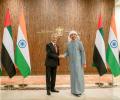
Frankly, was it really necessary in the middle of a fratricidal war for External Affairs Minister S Jaishankar to travel to Abu Dhabi for a one-on-one with the sheikh on April 12?Or, for National Security Advisor Ajit Doval to follow up on April 26? Or, for PM Narendra Modi to follow through today? There are no easy answers, notes Ambassador M K Bhadrakumar.

Two India-bound LPG tankers have crossed the Strait of Hormuz amid heightened tensions in the region, while an India-flagged vessel sank after being hit near the strategic shipping corridor.

The incident came shortly after a spokesperson from Iran's military warned that Tehran could target ports and docks in the United Arab Emirates following recent United States strikes on Kharg Island, a key hub for Iran's oil exports.

India is evaluating its involvement in the Chabahar port project in Iran due to potential US tariffs. The US had granted India a waiver for the project, but it expires soon. India is exploring options to continue supporting the port's development while minimizing exposure to US sanctions.

US Special Representative Sergio Gor met with Sri Lankan President Anura Kumara Dissanayake to discuss strengthening bilateral relations and Sri Lanka's stance on the Middle East crisis. The visit occurs amidst regional tensions and US efforts to secure trade routes in the Indo-Pacific.

Iran has announced the Strait of Hormuz is open to commercial vessels, coinciding with a ceasefire between Lebanon and Israel.

An Iranian delegation, led by Foreign Minister Abbas Araghchi, is expected to arrive in Islamabad for the second round of peace talks with the US, according to Pakistani media reports. This follows a phone call between Deputy Prime Minister Ishaq Dar and Araghchi regarding the US-Iran ceasefire and Pakistan's diplomatic efforts.

Despite a ceasefire extension, Iran has rejected the United States' conditions for negotiations, creating uncertainty in ongoing diplomatic efforts.

An India-bound container vessel, the 'Epaminondes', was seized by Iran's Islamic Revolutionary Guard Corps in the Strait of Hormuz, with an Indian merchant navy officer from Rajasthan among the crew, his family reported. The family has appealed to the Indian government for assistance in ensuring the safe return of the crew.

The Israel Defence Forces (IDF) confirmed the missile launches in a statement on Telegram, noting that defensive systems were actively operating to intercept the threat.

India has denied making any payments to Iran to secure safe passage for its vessels through the Strait of Hormuz, following reports that Indian vessels were fired upon in the region.

Indian refiners have access to only limited Iranian volumes compared with Russian oil, and even the barrels on offer come with 'too many hassles'.

Chinese Foreign Minister Wang Yi has urged Iran to guarantee freedom and safe passage through the Strait of Hormuz, a critical waterway for global oil trade, amid ongoing tensions with the US.
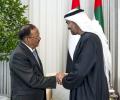
India is the only significant power that all parties trust, or at least do not distrust, notes former defence secretary Ajay Kumar.

The clock on the ceasefire is running out. But everyone's already whispering about round two, possibly as soon as this weekend.

The tanker reportedly switched off its Automatic Identification System (AIS) transponder while navigating the high-risk stretch of the strait and reappeared on tracking systems on March 9.

India's involvement in the port development was not strictly under the international sanctions that had been imposed on Iran.

An Indian-flagged LPG vessel successfully transited the Strait of Hormuz, reducing the number of Indian ships stranded in the Persian Gulf. India is in talks with Iran to ensure safe passage for its tankers, and Indian refiners continue to purchase crude oil and LPG from Iran despite regional tensions.

The US torpedo attack on the Iranian warship IRIS Dena in international waters was a lawful act of war between belligerents, not a diplomatic or strategic embarrassment for India, asserts Vice Admiral Biswajit Dasgupta (retd).

US President Donald Trump on Thursday said that he has directed the country's Navy to take decisive action against any vessels attempting to lay mines in the strategically vital Strait of Hormuz amid escalating tension over the virtual control of the waterway between Tehran and Washington.

A senior Iranian legislator has suggested that Tehran could further escalate pressure on its adversaries by targeting the Bab el-Mandeb Strait, raising concerns about global supply chain vulnerabilities.

On Saturday, it was reported that a drone strike had targeted the Fujairah Port in the UAE, triggering a fire.

The Indian government has refuted reports suggesting a deal with Iran involving the release of seized oil tankers in exchange for safe passage of Indian vessels through the Strait of Hormuz.

JNPT, the country's largest container port at Navi Mumbai, and Kandla in Gujarat's Kutch, the largest port by total cargo, will come together to form a Special Purpose Vehicle to operate the terminal at Chabahar, under a revenue-share agreement with the Port and Maritime Organisation, Iran.

The USS Tripoli, carrying around 3,500 US Marines, has entered the United States Central Command (CENTCOM) area of responsibility, marking the deployment of one of America's largest amphibious assault ships into an active combat theatre in West Asia amid the ongoing conflict.

The Americans can occupy Bab el Mandeb, claim to have 'solved' the Strait of Hormuz crisis, declare victory that President Trump so desperately needs, points out Colonel Anil A Athale, former head of the history division, ministry of defence.

Karex, the Malaysian company that makes roughly one in five of the world's condoms -- about five billion a year, supplying Durex and Trojan among others -- announced this week that it is raising prices by up to 30 percent. The reason is the Strait of Hormuz.

Donald Trump has issued a stern warning to Iran, stating that the US will take a tougher stance if a diplomatic resolution regarding its nuclear programme is not reached soon.
Following the death of Iranian sailors in the Indian Ocean, Iran's navy has threatened 'deadly retaliation,' accusing the US of attacking its warship off the coast of Sri Lanka, escalating tensions in the region.

The escalating conflict in West Asia has resulted in 19 ships carrying essential energy resources for India being stranded in the Strait of Hormuz, raising concerns about potential disruptions to the country's energy supply.

The chairman of maritime company Safesea Group has described the attack on the US-owned crude oil tanker Safesea Vishnu, which resulted in the death of an Indian crew member, as "deliberate and calculated". He emphasised the need for governments to ensure the safety of commercial shipping lanes and seafarers.
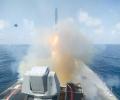
'India was not obliged to protect the Iranian ship.' 'Once the Iranian ship left Indian waters, she was on her own.' 'Guilt tripping India is wrong.'
Two more Indian-flagged LPG tankers have safely navigated the Strait of Hormuz, ensuring continued cooking gas supply to India amidst regional conflict. These tankers are expected to reach Indian shores soon, following the successful transit of previous vessels.

A Palau-flagged oil tanker with 15 Indian crew members was attacked off the coast of Oman, resulting in injuries. The incident occurred amidst rising tensions in the Middle East following attacks between Iran, the US, and Israel.

The Islamic Revolutionary Guard Corps (IRGC) has declared the commencement of its 27th offensive under Operation True Promise 4, targeting American and Israeli positions in response to what it termed a new wave of 'unprovoked US-Israeli aggression against the Islamic Republic', Iranian state broadcaster Press TV reported.

Major General Amir Hatami, commander-in-chief of the Iranian Army, condemned the attack on the vessel, one of the country's newest warships, which occurred while it was returning from a military exercise.

India's fertiliser subsidy bill for the current financial year (FY27) is projected to increase by approximately 20% due to surging global prices, primarily driven by the West Asia crisis, a senior official confirmed. Despite this, retail prices for urea and di-ammonium phosphate (DAP) will remain unchanged, ensuring adequate supply for the kharif season.

Indian benchmark indices Sensex and Nifty experienced volatility due to conflicting developments in West Asia, including reports of the Strait of Hormuz closure, which led to a rebound in crude oil prices and heightened investor concerns about supply disruptions and inflation.

The United States is facing growing discontent from its Gulf allies after several countries in the region complained that they were not given advance notice of the US-Israel strike on Iran that triggered widespread retaliatory attacks, according to media reports.

'The next two to three weeks will not be decided in Washington.' 'They will be decided in Tehran, in whatever calculation Iran makes about the costs of continued resistance against the costs of appearing to have yielded.'
